
ReFood Germany: one-year anniversary of the first gas-to-grid plant
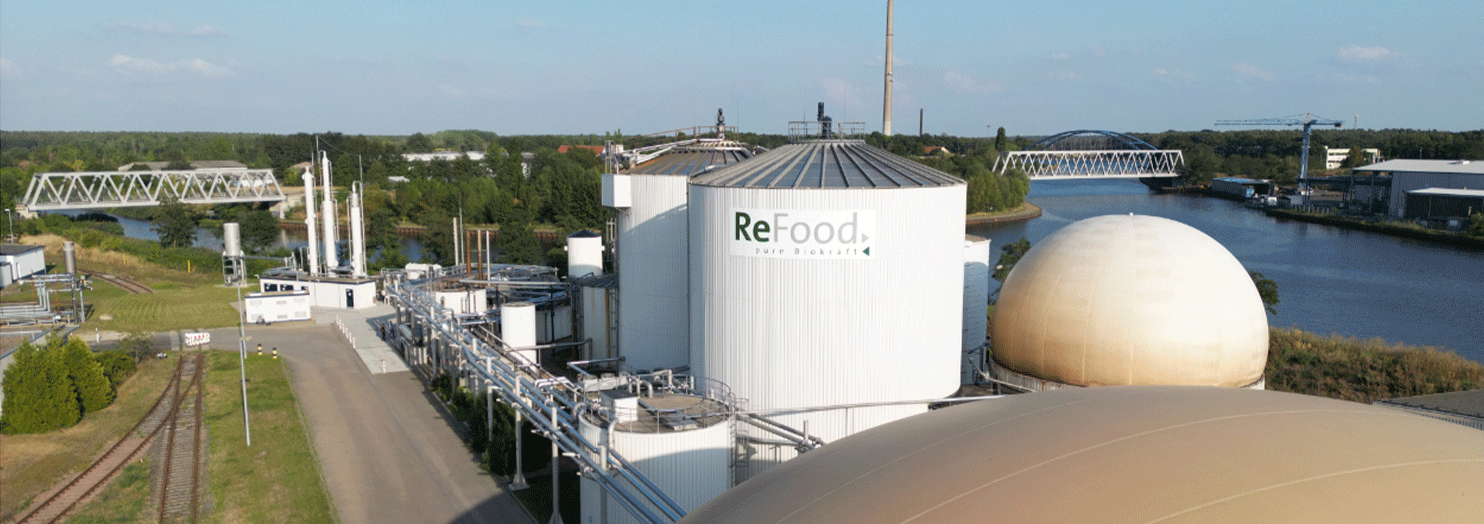
It was a long way from the idea to the final construction of the first gas-to-grid plant for ReFood Germany at the AD biogas plant in Genthin. Therefore, the local ReFood-Management is even happier that the first birthday of the new plant will be celebrated in September 2022.
In the gas-to-grid plant, the raw gas from the AD biogas plant is cleaned of its CO2 component by using physical absorption after desulfurization, so it can be supplied as biomethane to the National Grid. To purify the raw biogas, an organic absorbent (solvent) is used to selectively remove gas components such as CO2 and hydrogen sulfide. The entire plant is extremely energy efficient, as no process heat input is required, and the total energy demand is less than 0.2 kWh/mN3 raw biogas.
At maximum capacity, the plant can process 350 standard cubic meters (Nm³) of biomethane per hour and is currently running at 100 percent capacity in normal operation. For the coming years of operation, maximum capacity utilization remains the declared goal. In addition, the company plans to liquefy the extracted CO2 in the future to use it in technical applications.
The plant cost 1.9 million euros to install. In addition, there were further investment costs of 2.1 million euros for, among other things, the pile foundation of the soil to ensure its load-bearing capacity, as well as for the installation of a modern desulfurization plant and the modernization of the process system of the biogas plant.
The installation of such a plant to produce grid-quality biomethane has several advantages. As an important element of renewable energy concepts, biomethane is an essential component to secure the energy supply of the future. In addition, the sales of biomethane have developed over the years into an efficient alternative to fossil fuels and direct electricity generation via combined heat and power plants. The increasing demand for self-sufficient and above all green energy supply, but also the fact that biomethane, in contrast to energy from direct power generation, can be stored, make this type of energy supply competitive and future-proof.
For the expansion at the Genthin site, the close connection to the National Grid was the key factor for the project realization, because the costs of a price-sensitive connection were avoided. The biogas plant in Genthin is located on the extensive site of a former washing powder factory, and the new plant was smartly positioned so that a future expansion can be implemented without any problems, should a third digester for the biogas plant be planned in the future.
In the UK, ReFood also operates two gas-to-grid plants in Widnes and Dagenham. In addition to the Genthin site, the ReFood plant in Kogel (GER) is also considering the installation of a similar project.
 English (UK)
 Deutsch
 Español
 Français
 Polski